


From Homemaker to Entrepreneur: The Journey of a Rural Woman Tea Producers
- Admin
- 5 days ago
- 3 min read
In the tea-growing regions of India, especially in remote districts like Karbi Anglong in Assam, tea has long been a way of life. For decades, small tea growers cultivated leaves on fragmented plots of land, often selling them to nearby factories or agents within hours of plucking. The system offered little flexibility, low bargaining power, and minimal returns. For women in these households, participation in the tea economy was largely invisible and limited to labour, not leadership.
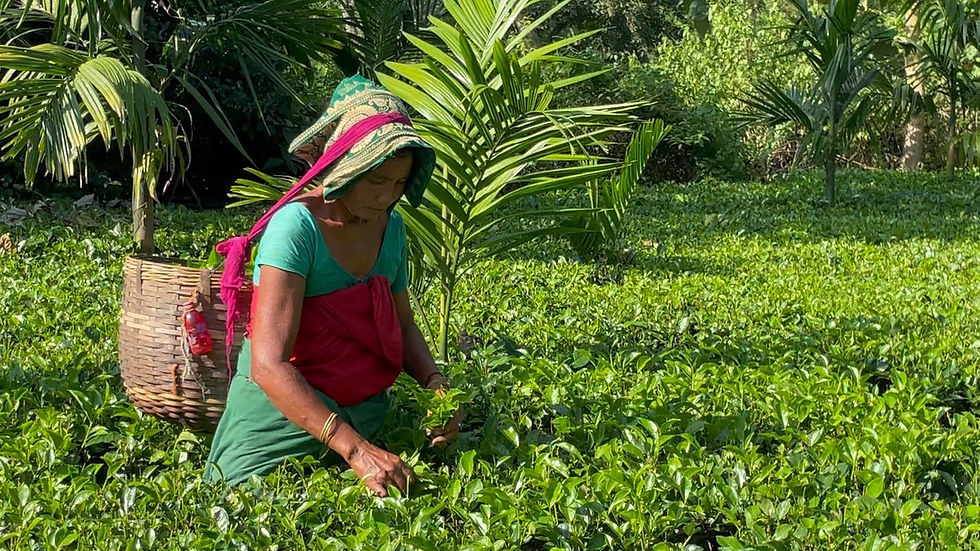
A woman plucking tea leaves
Now, across clusters of villages, rural women are stepping into a new role as entrepreneurs in the tea value chain. These women, known as Rural Women Entrepreneurs (RWEs), are not just growing tea; they are processing, managing, and collectively owning a part of the value creation process. Their journey reflects a shift from subsistence to enterprise, from isolation to collective strength.
The transformation begins at the household level. Women who once assisted in plucking tea leaves are now actively engaged in cultivating chemical-free green leaf from small, carefully managed plots. But the real shift happens beyond cultivation. In small groups of three to four, RWEs come together in cluster-based setups to process artisanal green tea. Steaming, cooling, rolling, drying, and packaging — every step is carried out with precision and coordination.
These clusters are more than production units; they are spaces of shared learning and mutual support. Each cluster typically consists of 8 to 12 women who collectively invest in basic infrastructure, such as a small processing unit. This shared ownership reduces individual risk while building a sense of collective responsibility.

Rural Women Entrepreneurs (RWEs)
Despite the progress, the challenges remain significant. RWEs operate in geographically remote areas with limited access to transportation, storage, and formal markets. Unlike other agricultural products, processed tea does not have a ready local market. Quality control, compliance requirements like food safety registration, and logistics add layers of complexity. Yet, what sets these women apart is their willingness to navigate these barriers together.
A key enabler in this journey has been the emphasis on aggregation both social and economic. By working in collectives, RWEs are able to produce in volumes that attract buyers, maintain more consistent quality, and negotiate better prices. Early batches of artisanal green tea, produced in small quantities, have already received encouraging feedback from buyers for their taste and quality. While price realization is still evolving, the shift from selling raw leaves to processed tea marks a significant step up the value chain.

Launching Premium Karbi Artisanal Green Tea at the Rural Udyamita Conference 2025
This model is not just about increasing income; it is about redistributing value. Traditionally, the higher-value segments of the tea industry such as processing, branding, and marketing were controlled by larger firms. By enabling RWEs to participate in these stages, the model creates opportunities for women to access a greater share of the final value.
Equally important is the question of governance. Efforts are underway to ensure that RWEs are not just participants but decision-makers. A three-tier structure consisting of cluster-level groups, block-level unions, and higher-level representation aims to give women a voice in operational and strategic decisions. This ensures that the system remains accountable to those at its foundation.

The journey from small tea grower to entrepreneur is not immediate, nor is it easy. It requires new skills, collective discipline, and sustained support systems. But it also brings dignity, confidence, and a sense of ownership that was previously out of reach.
As these rural women continue to refine their craft and strengthen their networks, they are quietly reshaping the tea value chain one batch, one cluster, and one decision at a time. To support Rural Women Entrepreneurs and equifarmtea’s mission of empowering Small Tea Growers, purchase your next pack of tea from www.grassrootstea.in/shop.


Comments